Showing posts with label myeloproliferative. Show all posts

Wednesday, February 23, 2011

Spotlight on New Investigators

MPD Foundation's staff and board are constantly revisiting what it means to fund research that produces results.  We look at the various ways the work we fund affects patients - from available treatments to increasing their understanding of the scientific underpinnings of their disorder.

We also happen to be impacting the lives of those in the research community, including a group we've focused on through our last two grant cycles: new investigators.  

This is a group we define as being new to the field of MPN or simply new to independent research and desiring to work in MPN.  Although we've funded up and coming researchers in the past, since 2008 it has been a goal of ours to target this group for funding along with our grants to more experienced investigators.  Both types of investigators are working towards the goal of finding the causes of and potential cures for the myeloproliferative neoplasms.  

On that note we'd like to introduce some of our newest grant recipients:


Wei Tong, PhD, Children's Hospital of Pennsylvania

Dr. Tong will be working on a project titled "K63 Ubiquitination in JAK2 Signaling and Myeloproliferative Neoplasms".  The bottom line is that Dr. Tong is trying to determine how LNK affects JAK2 signaling.  JAK2 is basically an on-off switch whose malfunction is present in many MPNs.  LNK normally regulates the JAK2 switch to prevent myeloproliferation; mutated versions fail to turn off the signaling.  


Toshiaki Kawakami, MD PhD, La Jolla Institute for Allergy and Immunology.

Dr. Kawakami's project is titled "SPS Complex in MPD".  In this project he will be studying a series of genes whose absence in mice is known to cause tumors and myeloproliferative neoplasms.  His hypothesis is that the same thing happens in humans, and if correct, the discovery could lead directly to new therapeutic targets for MPN drug development.


Saghi Ghaffari, MD PhD, Mt. Sinai School of Medicine

Dr. Ghaffari's project is titled "Understanding Molecular Mechanisms of Regulation of Myeloproliferative Disorders in Mouse and Human".  With this project Dr. Ghaffari will be investigating a different signaling mechanism altogether whose failure may be responsible for myeloproliferation.  This is important because the JAK2 mutation is not present in all MPN patients; there must be at least one other mutation to account for those cases.


We will monitor their progress and report back as their work develops.  As one of the only organizations serving the needs of patients with myeloproliferative neoplasms we are committed to not only funding such projects but also to providing information and support for MPN patients.    

Monday, September 20, 2010

Not your mother's PV: A young patient's battle with Polycythemia Vera

Special guest post by PV patient Donna B.  

The polycythemia vera part of my story began in August 2006, when I was diagnosed.  I went to the hospital with abdominal pain and an enlarged spleen, and several tests (and weeks) later I started phlebotomy treatments.  I was 29 years old.  That’s not the whole story.  

In January 2002, I was diagnosed with a portal vein thrombosis – or as I tell most people “a blood clot in my liver.”  That diagnosis came after several weeks of abdominal pain and several wrong diagnoses ranging from gastritis to a pulled muscle.  Back then, the clot was attributed to Factor V Leiden, a genetic clotting disorder that, while still uncommon, is more common that PV.  The Factor V Leiden diagnosis effectively masked the fact that I also had PV until 2006, when I tested positive for JAK2.

Really, the story begins as early as summer 2000, when I began experiencing chronic headaches and fatigue.  Checked against the headache symptoms I dug up online, I found that my headaches combined features of tension headaches (pressure on the back and sides of my head), migraines (visual aura) and cluster headaches (stabbing pain over one eye).  I figured that all of these symptoms must be stress-induced, and kept them in check with over-the-counter pain relievers.

I’ve been on Coumadin since that clot was discovered in 2002, and while it was enough to keep my alive, it clearly wasn’t enough to keep me healthy.  I spent a lot of time in the hospital between 2003 and 2005, and have the scars to prove it.  

Phelobotomy ended up not being enough to keep me healthy, either.  Week after week, pint after pint of my “extra thick and chunky style” blood was drained, and yet my spleen was still causing me pain. As long as I sat perfectly still I was reasonably comfortable.  A slow shuffle was bearable for short distances.  The acts of sitting down and standing up were agony.  It was like being kicked in the stomach and kidney at the same time.  Lying down to sleep was not an option.

So, I began taking Hydroxyurea.  My doctor had some reservations about me taking it, because I am young for a PV patient, and long-term risks of taking the drug haven’t been completely ruled out.  I took it for a year with no side effects.  The pain in my spleen finally resolved, and my phlebotomy treatments were reduced to every couple of months.

Weekly Pegasys injections had been mentioned to me as a treatment back in 2006. Because it was seen as very promising and doesn’t carry the long-term risks, I wanted to try it right away. Unfortunately, my insurance wouldn’t pay for it.  It would, however, pay for thrice-weekly Interferon injections, which I began in October 2007.

Headaches.  Fevers.  Achy joints.  It was like I had the flu three nights a week.  I sometimes felt very tired the next day. My hair thinned.  I never got depressed, but I think the darker, more introspective side of my personality became more dominant.  My tastes changed, too: I stopped putting sugar in my coffee and switched from eating cereal for breakfast to eating yogurt.  

Why did I stay on it?  I didn’t mind the changes that much. What mattered was how I felt overall, and overall I felt pretty good. I adjusted to the symptoms, taking the shot just before bed and chasing it with a couple of Tylenol.  I started playing softball with some friends and found that when I was outside on the field I felt better than I had in years. 

I took Interferon for two years.  The symptoms eased up after the first year.  Now, I only felt flu-ish one night a week.  I got used to jabbing myself with a needle.  Then, last December, I stopped.  There had been a recall of the form of Interferon that I was taking, and I had to switch to a different form.  For whatever reason, my blood counts dropped.  My doctor thought I’d be better off without the Interferon for a few weeks. When I went in for my next blood test, my counts had all risen again.  It seemed clear that they would keep rising if left unchecked.  Coincidentally, a new study had just been released that extolled the benefits of Pegasys for PV patients.  I walked out of the clinic that day with a one-month supply.

I’ve been on it since then.  If there are side effects, I don’t notice them.  I no longer shed more hair than my dog.  I can take my weekly shot and leave the house without feeling sick.  The most inconvenient aspect is that I have to visit the doctor every couple of weeks for a blood test.  Pegasys has been very effective for me, as well.  I started on 90 miu a week, and now I’m down to 45 miu every other week.  Even at this level, my counts are at the low end of normal.  I think that, if I had never had PV then this is where my blood counts would naturally gravitate, but there’s no way to know for sure.  

I feel really good.  I play softball and go rollerblading and hiking.  I still eat yogurt for breakfast and never put sugar in my coffee.  I know that the test results are important, but the way I feel matters more to me than the numbers, especially since it was the way I felt that told me I was sick in the first place.

This is the first of many personal stories from patients.  Feel free to share your story in the comments section or contact me at mwoehrle@mpdfoundation.org to tell your own MPD story on this blog. 
Thursday, July 22, 2010

Meeting of the minds for MPD researchers

MPD Foundation grantees meet at ASH
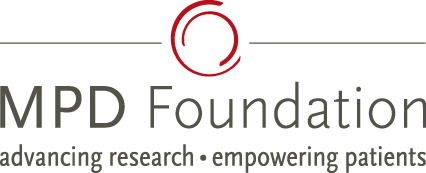
The annual meeting of the American Society of Hematology takes place each year in early December.  For the past 2 years the MPD Foundation has exhibited, distributing our free patient brochure as well as speaking with hematologists who specialize in MPDs about treatments and patient numbers.  During these events we also take time to meet face to face with MPD researchers who have been awarded or applied for our grants.  This past December we had the opportunity to meet with our current Research Alliance and New Investigator grantees in New Orleans.  

The MPD Foundation believes collaboration is an essential ingredient for accelerating the rate of progress for medical research.  The academic research environment often presents barriers to sharing insights and open communication among researchers who may be in competition with potential collaborators.  However, at ASH we found fewer barriers to communication among our New Investigators as Drs. Delhommeau, Kralovics and Braun (Dr. Sipkins could not attend) communicated freely among one another, discussing research progress and findings.  

In 2011 the MPD Foundation will be awarding new grants and once again emphasizing collaboration along with science that will drive treatments forward.  With each series of grantees we learn more about what it takes to emphasize what MPD patients need from medical research and science.  Right now it appears that organic collaborations are most effective in creating real communication between scientists.  It is this sharing of information that we think will accelerate the understanding of MPDs and bring about better and more treatments. 

Friday, July 2, 2010

Challenge Grants

Requests for proposals (RFP) for MPD Foundation's 2010 Challenge Grant program left the office in May, making their way into the hands of researchers actively involved with or thinking about getting into the world of myeloproliferative disorders. MPD Foundation grant programs have gone through several incarnations that illustrate how our priorities have changed as we learn more.

The MPD Research Alliance was our collaborative program aimed at accelerating development of new treatments following the 2005 discovery of the JAK2 mutation associated with MPDs. In 2008 a category of grant was added that recognized the need for funding of researchers new to MPDs. We are proud that the New Investigator grant program has been enormously successful.

In 2011 the MPD Foundation will award a new set of grants through our 2010 Challenge Grant program. The goal is to focus on both basic and translational research. This grant program is following up on the new and intriguing discoveries upon which we hope new treatments can be discovered.

This new grant program is consistent with our role as a patient-driven organization.  Our intention is to explore all options that could lead to discoveries that benefit patients with myelofibrosis, polycythemia vera and essential thrombocythemia.  In that sense we are ourselves constantly challenging the idea that a motivated group of individuals can't make a difference. We can't wait to see how the new group of MPD researchers will challenge themselves with these new grant proposals.